How to Report Airbnb Income to HMRC: The Complete 2026 Guide
If you’re renting out a property on Airbnb in the UK, you need to report your income to HMRC. Since January 2024, Airbnb (and other platforms) are legally required to share your earnings directly with HMRC — so there’s no hiding from it. Here’s exactly what you need to do.
Do I Need to Report My Airbnb Income?
Yes, if your total rental income exceeds £1,000 per year. The property income allowance means you don’t need to report income under £1,000 — but anything above that must be declared on a Self Assessment tax return.
| Your situation | What to do |
|---|---|
| Income under £1,000/year | No reporting needed (property income allowance) |
| Income £1,000–£2,500 | Contact HMRC, they may adjust your tax code |
| Income over £2,500 | You must file a Self Assessment tax return |
| Furnished Holiday Let (FHL) | Report as business income with additional rules |
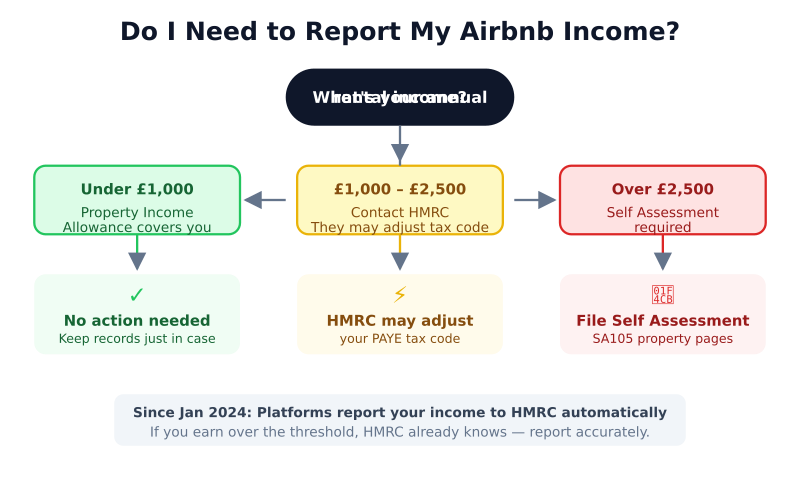
Do I need to report my Airbnb income? Decision tree
What Changed in 2024?
The biggest change: Airbnb and other platforms now report your income to HMRC automatically. Under OECD Digital Platform Reporting rules, platforms must share:
- Your total earnings for the tax year
- The number of bookings/transactions
- Your identity and tax details
This means HMRC already knows what you’ve earned. The question isn’t whether to report — it’s how to report it correctly.
The New Digital Platform Reporting Rules
Online platforms like Airbnb, Booking.com, and VRBO must now file annual reports with HMRC using a standardised XML format (OECD DPI v2.0). This data includes:
- Property owner name and address
- Total gross income per property
- Number of rental days
- Platform fees deducted
HMRC cross-references this with your Self Assessment. If the numbers don’t match, you could face penalties.
How to Report: Step by Step
Step 1: Gather Your Records
You need to track:
- Gross income from each platform (Airbnb, Booking.com, VRBO, etc.)
- Allowable expenses (cleaning, maintenance, insurance, mortgage interest, etc.)
- Property details (address, ownership split if joint)
- Rental days for each property
Step 2: Calculate Your Taxable Income
For standard rental income:
Taxable income = Gross income − Allowable expenses
For Furnished Holiday Lets (FHL): You can claim capital allowances on furniture and equipment, and profits count as earnings for pension contributions. Note: the FHL regime is being abolished from April 2025 — more on this below.
Step 3: File Your Self Assessment
Report your property income on the SA105 (Property Income) supplementary pages. You’ll need to include:
- Total income from each property
- Expenses claimed
- Any losses carried forward
Step 4: Pay Your Tax
Tax is due by 31 January following the tax year. For the 2025/26 tax year, payment is due by 31 January 2027.
What About Multiple Platforms?
If you list on Airbnb and Booking.com and VRBO, you need to consolidate income across all platforms. This is where it gets messy — and where tools like HMRC Reporter can help by automatically:
- Importing CSV data from multiple platforms
- Matching properties across listings
- Converting currencies (for international bookings)
- Generating HMRC-compliant XML reports
Furnished Holiday Let Changes (April 2025)
From April 2025, the Furnished Holiday Let (FHL) regime is being abolished. This means:
- FHLs will be treated as standard residential property income
- You’ll lose the ability to claim capital allowances on new items
- Mortgage interest relief changes to the standard 20% tax credit
- Capital gains tax reliefs (Business Asset Disposal Relief) no longer apply
If you currently qualify as an FHL, speak to a tax adviser about the transition.
Common Mistakes to Avoid
- Not declaring because Airbnb “handles it” — Airbnb reports your income, but doesn’t file your tax return for you
- Forgetting about other platforms — HMRC gets data from ALL platforms, not just Airbnb
- Missing the property income allowance — If under £1,000, you don’t need to report at all
- Claiming non-allowable expenses — Personal use days, capital improvements (unless FHL), and fines aren’t deductible
- Late filing — Penalties start at £100 and increase quickly
Frequently Asked Questions
Q: Do I need to register for Self Assessment if I only rent one room? A: Yes, if your rental income exceeds £1,000 per year (before expenses).
Q: Can I use the Rent a Room scheme instead? A: Yes, if you’re renting a room in your own home. The threshold is £7,500 per year (£3,750 if shared). This is separate from the property income allowance.
Q: Will I be taxed on the full Airbnb payout or after fees? A: You report gross income (before platform fees). Platform fees are an allowable expense you deduct.
Q: How does HMRC know about my Airbnb income? A: Since January 2024, Airbnb and all major platforms report your earnings to HMRC under OECD Digital Platform Reporting rules.
Need help generating your HMRC Digital Platform Report? HMRC Reporter automatically converts your booking data from 27+ platforms into compliant XML reports. Get started →
📊 Free: MTD Readiness Checklist for Property Managers
Find out if you're ready for Making Tax Digital — and what to fix before April 2026. Download the free checklist.
Download Free Checklist →